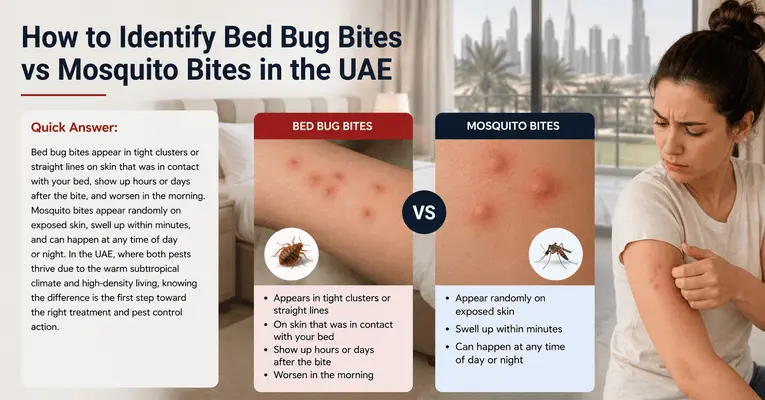
Bed bug bites appear in tight clusters or straight lines on skin that was in contact with your bed, show up hours or days after the bite, and worsen in the morning. Mosquito bites appear randomly on exposed skin, swell up within minutes, and can happen at any time of day or night. In the UAE, where both pests thrive due to the warm subtropical climate and high-density living, knowing the difference is the first step toward the right treatment and pest control action.
Why Does This Question Matter More in the UAE Than Almost Anywhere Else?
If you have woken up in your Sharjah apartment or Sharjah villa covered in red, itchy bumps and you are not sure what bit you, you are far from alone. Residents across the Emirates face this confusion regularly, and the stakes are higher here than in many other parts of the world.
The UAE’s warm climate creates conditions that are ideal for both Cimex lectularius (the common bed bug) and Culicidae species such as Aedes aegypti and Culex quinquefasciatus (dengue-transmitting and nuisance mosquitoes). According to pest control specialists operating in Sharjah, bed bugs reproduce faster in warm environments than in cooler regions, with females capable of laying between 200 and 500 eggs over a lifetime. Meanwhile, mosquitoes are a year-round concern in coastal emirate zones, particularly around stagnant water near residential compounds and construction sites.
Misidentifying the bite source leads to delayed pest control treatment, which can allow an infestation to spread across shared walls and corridors in high-rise buildings. Getting this identification right protects both your health and your home.
What Do Bed Bug Bites Look Like?
Bed bug bites are small, red, and raised with a slightly darker center where the insect pierced the skin. They tend to look like tiny pimples at first, and in people who are highly sensitive, they may fill with fluid and become more blister-like over time. The surrounding skin often appears paler than normal.
One of the most telling characteristics of bed bug bites is their arrangement. They almost never occur as a single isolated bite. Instead, they appear in groups of three, in zigzag lines, or in tight clusters. Pest control professionals often refer to this three-bite arrangement as the “breakfast, lunch, and dinner” pattern, a phrase that captures how bed bugs feed multiple times during a single nightly session.
The timing of when the bites become noticeable is also a key clue. Because bed bugs inject a mild anesthetic before feeding, you will not feel anything during the attack. The itching and redness typically develop hours later and are usually most intense in the morning. As the day progresses, the discomfort often eases slightly. In more severe reactions, you may experience localized swelling, hives, or prolonged skin irritation.
What Do Mosquito Bites Look Like?
Mosquito bites behave very differently from bed bug bites. The reaction is almost immediate. Within minutes of being bitten, a puffy white or pink welt forms at the site, often with a small visible puncture in the center. This initial raised bump may then transition into a reddish-brown mark over the following day.
Most people experience mild to moderate itching. However, some individuals develop what is clinically referred to as Skeeter Syndrome, an allergic response to proteins in mosquito saliva that produces large, red, painful welts and can, in rare cases, progress toward anaphylaxis. Children and people with compromised immune systems are more susceptible to this kind of reaction.
Where on Your Body Do Mosquito Bites Appear?
Mosquito bites follow no particular pattern or cluster formation. They show up randomly across any area of exposed skin, most commonly on the legs, face, back of the neck, forearms, and ankles. Since mosquitoes are attracted to carbon dioxide, body heat, and movement, bites often concentrate around the head and lower limbs depending on posture and activity.
Side-by-Side Comparison: Bed Bug Bites vs Mosquito Bites in the UAE
| Feature | Bed Bug Bites | Mosquito Bites |
| Appearance | Small red pimple-like welts with darker center | Puffy white or pink bump, sometimes with puncture mark |
| Pattern | Clusters, zigzag lines, or straight rows | Random and scattered |
| When symptoms appear | Hours to days after the bite | Within minutes |
| Time of bite | Almost exclusively at night during sleep | Day, dusk, or night |
| Location on body | Exposed skin near bed contact points | Any exposed skin, especially lower limbs and face |
| Itching peak | Morning subsides during the day. | Immediate and persistent |
| Disease transmission | None | Dengue and malaria (via Aedes aegypti and Anopheles). |
| Signs of infestation | Rust-colored stains on sheets, shed exoskeletons | Stagnant water nearby, buzzing sound. |
The UAE Context: Why Both Pests Are a Genuine Health Concern
Understanding which insect bit you in the UAE is not just about comfort. It is a public health matter.
Mosquitoes in the UAE, particularly Aedes aegypti and Culex species, are capable of transmitting dengue fever and other vector-borne diseases. Research published in scientific literature confirms that the dengue virus is present in the broader Arabian Peninsula region, with outbreaks documented in neighboring countries. Sharjah’s status as a global travel hub means residents and visitors are regularly exposed to travelers arriving from high-risk dengue zones across South and Southeast Asia, Africa, and Latin America.
Bed bugs, on the other hand, do not transmit diseases. However, the psychological impact of a bed bug infestation is well documented and includes insomnia, anxiety, and persistent skin inflammation. In the UAE, Sharjah Municipality regulations require that only licensed pest control companies apply pesticides or fumigate buildings, making professional intervention the appropriate and legal route for serious infestations.
The UAE’s dense residential towers, frequent hotel stays, second-hand furniture markets, and the transient nature of its expat population all create pathways for bed bugs to spread rapidly from one unit to another.
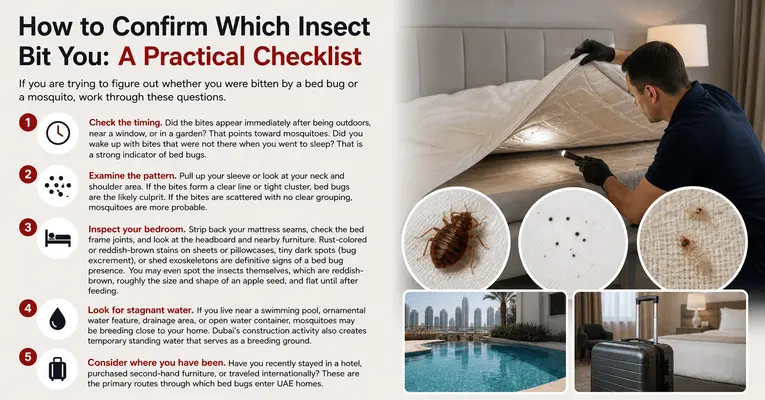
How to Confirm Which Insect Bit You: A Practical Checklist
If you are trying to figure out whether you were bitten by a bed bug or a mosquito, work through these questions.
Check the timing. Did the bites appear immediately after being outdoors, near a window, or in a garden? That points toward mosquitoes. Did you wake up with bites that were not there when you went to sleep? That is a strong indicator of bed bugs.
Examine the pattern. Pull up your sleeve or look at your neck and shoulder area. If the bites form a clear line or tight cluster, bed bugs are the likely culprit. If the bites are scattered with no clear grouping, mosquitoes are more probable.
Inspect your bedroom. Strip back your mattress seams, check the bed frame joints, and look at the headboard and nearby furniture. Rust-colored or reddish-brown stains on sheets or pillowcases, tiny dark spots (bug excrement), or shed exoskeletons are definitive signs of a bed bug presence. You may even spot the insects themselves, which are reddish-brown, roughly the size and shape of an apple seed, and flat until after feeding.
Look for stagnant water. If you live near a swimming pool, ornamental water feature, drainage area, or open water container, mosquitoes may be breeding close to your home. Dubai’s construction activity also creates temporary standing water that serves as a breeding ground.
Consider where you have been. Have you recently stayed in a hotel, purchased second-hand furniture, or traveled internationally? These are the primary routes through which bed bugs enter UAE homes.
Treating Bites at Home: What Works in the UAE Climate
For both types of bites, the basic principles of relief are similar, but there are important differences.
Treating Bed Bug Bites
Wash the affected area with soap and water. Apply a mild corticosteroid cream, which is widely available at pharmacies across Sharjah and Al Nahda, to reduce inflammation and itching. Antihistamines such as cetirizine or loratadine can help with more intense allergic responses. Avoid scratching, as this increases the risk of secondary bacterial infection in the UAE’s humid summer months.
If the bites are severe, spreading, or accompanied by fever or significant swelling, consult a dermatologist. Clinics in major UAE cities are well equipped to handle insect bite reactions and can differentiate between a bite and a skin condition such as eczema or scabies, which can produce similar-looking lesions.
Treating Mosquito Bites
An ice pack applied to the bite immediately after it occurs helps reduce swelling. Calamine lotion and over-the-counter antihistamine creams are effective. For anyone experiencing signs of Skeeter syndrome, such as blistering, extreme swelling, or hives, medical attention should be sought promptly.
If you develop fever, joint pain, or fatigue within two weeks of receiving mosquito bites, particularly after travel to or from dengue-endemic regions, visit a clinic and request a dengue NS1 antigen test or a complete blood count. Early detection of dengue fever significantly improves outcomes.
Preventing Bed Bug and Mosquito Bites in UAE Homes
Prevention looks different for each pest, and the UAE’s unique living environment calls for strategies that address both simultaneously.
Preventing Bed Bugs in the UAE
Inspect hotel rooms before unpacking when traveling. Check mattress seams and the area behind headboards. Keep luggage elevated on metal stands rather than placing it on the floor or bed. When purchasing second-hand furniture from markets in Sharjah, Al Nahda, or similar areas, inspect it thoroughly before bringing it indoors.
Mattress encasements with zipper closures trap any existing bed bugs and prevent new ones from establishing themselves in the mattress fabric. Regularly launder bedding on a high-temperature wash cycle, ideally above 60 degrees Celsius. Declutter storage areas near sleeping spaces, as bed bugs thrive in undisturbed environments.
If you suspect an infestation, contact a Sharjah Municipality-approved pest control company immediately. Chemical treatments have been shown to outperform natural methods in the UAE’s warm indoor climate, and professional heat treatment, which involves exposing infested rooms to temperatures above 60 degrees Celsius for a sustained period, is effective against both adult bed bugs and their eggs.
Preventing Mosquito Bites in the UAE
Install window and door screens and keep them in good repair. Use DEET-based or picaridin insect repellents when spending time outdoors, especially during the evening hours when Culex mosquitoes are most active. Remove any source of stagnant water from your balcony, garden, or compound, including plant pot saucers, water containers, and bird baths.
Mosquito nets are a practical option for bedroom use, particularly in older buildings or villas where screens may be absent. Outdoor fogging services are available from licensed pest control companies and are especially useful for garden villas and compounds during the humid summer season.
When to See a Doctor in the UAE
Seek medical attention for bites if you notice any of the following.
The bite site becomes increasingly red or warm to the touch or begins to show red streaks radiating outward, which may indicate a secondary bacterial skin infection. You develop a significant fever or flu-like symptoms after mosquito exposure. The itching or swelling is so severe that over-the-counter treatments provide no relief. You experience difficulty breathing or throat tightening following insect bites, which requires emergency care at the nearest hospital.
Sharjah Health Authority and Department of Health Abu Dhabi licensed facilities across the UAE are well positioned to treat insect bite complications and can refer to specialist dermatologists or infectious disease physicians when needed.
Frequently Asked Questions
Can bed bugs bite you outside the bedroom in the UAE? Yes. While beds are the most common harborage site, bed bugs can establish themselves in sofas, armchairs, behind electrical outlets, and even inside luggage. In high-rise buildings, they can travel through wall voids and common corridors to reach adjacent apartments.
Do mosquitoes in Sharjah carry dengue? The Aedes aegypti mosquito, which is the primary vector of dengue fever, is present in the UAE. While locally transmitted dengue cases are less common than in neighboring countries, imported dengue cases among residents returning from travel are a documented public health concern.
Can you have bed bug bites without seeing the insects? Absolutely. Bed bugs are nocturnal and expert hiders. The absence of visible insects does not rule out an infestation. Rust stains on bedding, a sweet musty odor in the room, and unexplained bite clusters every morning are sufficient reason to have a professional inspection conducted.
Why do some people in the UAE not react to bed bug bites? Reactions to bed bug bites vary considerably between individuals. Some people show no visible skin response at all, while others develop intense welts. This variability has led many UAE residents to dismiss an infestation entirely, allowing it to grow undetected for months.
How do I know if my itchy rash is from bed bugs, mosquitoes, or something else like scabies or heat rash? Scabies, caused by the mite Sarcoptes scabiei, produces persistent burrowing lines under the skin and intense nighttime itching, particularly between the fingers and around the wrists. Heat rash, or miliaria, appears as small uniform red dots and is typically located on areas covered by clothing. Neither follows the cluster or linear pattern of bed bug bites, and neither produces the random scattered appearance of mosquito bites. A dermatologist can confirm the diagnosis with a skin examination.
Summary
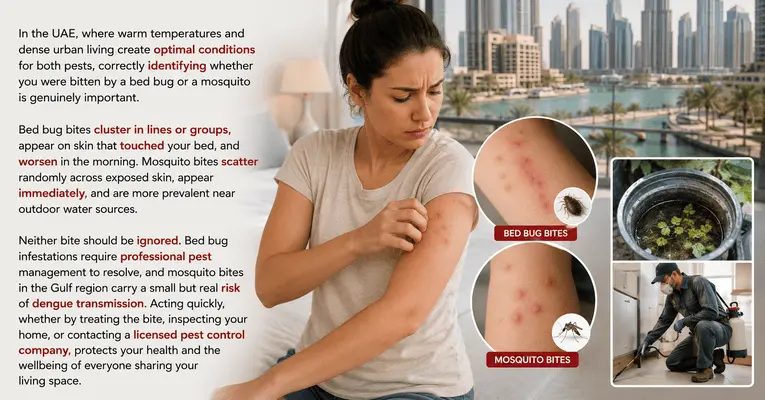
In the UAE, where warm temperatures and dense urban living create optimal conditions for both pests, correctly identifying whether you were bitten by a bed bug or a mosquito is genuinely important. Bed bug bites cluster in lines or groups, appear on skin that touched your bed, and worsen in the morning. Mosquito bites scatter randomly across exposed skin, appear immediately, and are more prevalent near outdoor water sources.
Neither bite should be ignored. Bed bug infestations require professional pest management to resolve, and mosquito bites in the Gulf region carry a small but real risk of dengue transmission. Acting quickly, whether by treating the bite, inspecting your home, or contacting a licensed pest control company, protects your health and the well-being of everyone sharing your living space.