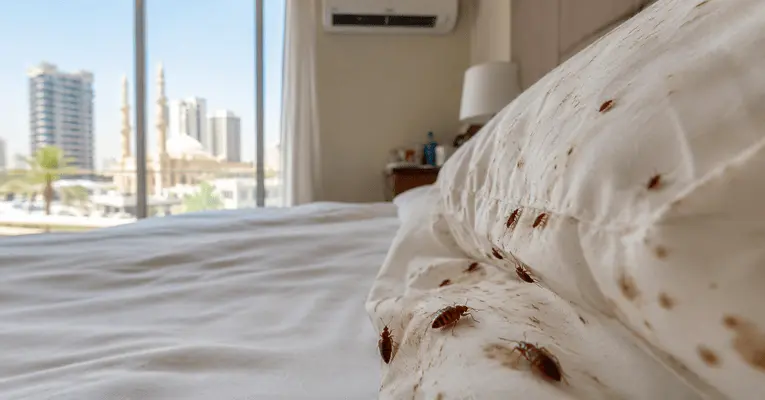
Yes, bed bugs not only survive Sharjah’s summer heat, they actually thrive during it. Despite outdoor temperatures regularly exceeding 42°C in July and August, bed bugs living inside air-conditioned homes, apartments, and hotel rooms in Sharjah are completely shielded from that extreme outdoor heat. Worse, the behavioral patterns of residents during summer months create near-perfect conditions for infestations to grow.
Why Everyone in Sharjah Is Asking This Question
If you have ever spotted tiny rust-colored marks on your mattress, woken up with itchy welts on your arms or neck, or caught a faint musty smell in your bedroom, you are probably already dealing with a bed bug problem and quietly hoping that Sharjah’s brutal summer will solve it for you.
It is a completely reasonable thought. July is the hottest month in Sharjah, with peak temperatures reaching 42.2°C (108°F). Most people assume that kind of heat would bake any pest into extinction. But here is the uncomfortable truth that pest control professionals across the UAE will confirm: the summer season does not kill bed bugs in Sharjah. In fact, it makes them more comfortable.
What Temperature Actually Kills a Bed Bug
Before understanding why Sharjah’s summer fails to eliminate bed bugs, you need to understand the science of how heat affects the insect Cimex lectularius, the species responsible for nearly every infestation inside UAE homes.
At 113°C (45°C), bed bugs begin dying, but the process takes time, and sustained exposure of 90 minutes or more is required to reach a reliable kill rate. At 118°F to 120°F (48°C to 49°C), adult bed bugs die within roughly 20 minutes, while eggs require a full 90 minutes at that same temperature to achieve complete mortality.
Adult bed bugs die at 119°F, and their heat-resistant eggs require temperatures upwards of 125°F to be eliminated. That translates to roughly 48°C to 52°C sustained for an extended period, throughout the entire space, with no cool pockets anywhere.
When exposed to heat, bed bugs and their eggs die due to desiccation, meaning the loss of water from their bodies, or thermal death. At temperatures between 47°C and 50°C, bed bugs’ bodies can no longer function, leading to death in a matter of minutes.
The key phrase in all of this is “sustained, sustained, sustained.” A momentary spike in temperature does nothing. The heat has to penetrate every crack, seam, mattress fold, and wall void where these insects hide, and it has to stay there long enough to break down their biology.
Sharjah’s Outdoor Heat vs. What Bed Bugs Actually Experience
Average daytime temperatures in June, July, and August in Sharjah hold steadily above 38°C, with maximum averages of 38.4°C in June, 39.1°C in July, and 39.3°C in August. Even the nights remain very warm, with average minimum temperatures in the range of 28°C to 31°C.
At first glance, those numbers look threatening to any pest. But here is the critical gap in that logic: bed bugs do not live outdoors. They live in your bedroom, inside your sofa cushions, behind your wall sockets, under your floorboards, and deep in the seams of your mattress. And in Sharjah, like the rest of the UAE, every indoor space runs on heavy-duty air conditioning from May through September.
Pest control companies operating in the UAE note that the parasitic insects thrive in the conditions provided by UAE homeowners during summer, despite it having nothing to do with the higher outdoor temperatures. The moment you walk indoors, you step into a 21°C to 24°C environment that keeps both you and the bed bugs perfectly comfortable.
The outdoor heat of Sharjah is essentially irrelevant to an insect living inside a climate-controlled room. The temperature that matters is the temperature inside your home, and that is kept deliberately cool for human comfort.
The Summer Surge: Why Infestations Actually Increase in Sharjah
This is the part that surprises most residents. An entomologist for a major pest control company in the UAE notes that his company sees twice as many calls due to bed bugs in the summer compared to winter. Calls come from labor camps, hotels, villas, and apartments, and they can appear anywhere because they can be transferred in so many ways.
So why does summer make things worse rather than better?
The first reason is increased travel. Sharjah is a transit and tourism hub, and during summer holidays, residents travel internationally and bring back bed bugs unknowingly in their luggage. Students returning home from universities abroad, families coming back from vacations, and visitors arriving from countries where infestations are common all contribute to the seasonal spike. Bed bugs are expert hitchhikers. They do not jump or fly. They crawl into the folds of a suitcase, hide in a jacket pocket, and travel with you across continents.
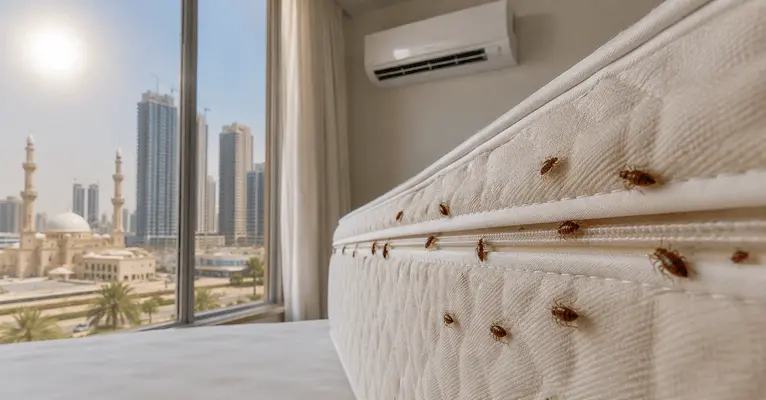
The second reason is increased indoor density. Because of the extreme outdoor heat, people in Sharjah spend significantly more time indoors during summer. More time in bed, more time on sofas, and less ventilation all create a feast-like situation for Cimex lectularius. The more frequently a human host is available and sedentary, the more feeding opportunities the insect has, which directly accelerates its reproductive cycle.
The third reason relates to humidity. Humidity in Sharjah in July can be notably high, fluctuating between 55% and 80% throughout the month. Higher indoor humidity slows down the natural desiccation that might otherwise inhibit bed bug eggs from hatching. Moisture in the environment prolongs their survival and increases egg viability.
Can You Use Sharjah’s Heat to Treat Infested Items?
Leaving a mattress outside in Sharjah’s summer heat sounds like a logical DIY approach. The reality is more complicated.
The pests cannot be eliminated simply by turning off heaters in winter or sitting infested items outdoors on a sunny summer day. Only extreme temperatures, beyond what can be achieved naturally, will eliminate them.
Even if outdoor air in Sharjah reaches 42°C or 43°C, the interior of a mattress, a stack of clothing, or a piece of furniture will not uniformly reach the 48°C to 52°C threshold required to kill all life stages. Bed bugs will simply retreat deeper into the insulation layer of a mattress or into a cooler interior pocket of a fabric item. They are remarkably good at thermoregulation by movement.
There is one partial exception worth mentioning. Leaving small, thin fabric items like clothing or pillowcases in a sealed black plastic bag in direct Sharjah sunlight for six or more hours can push interior temperatures high enough to kill some life stages, though this approach is unreliable for thicker items and should never be considered a standalone treatment.
For actual heat treatment that works, professional-grade equipment is required. Professional pest control in the UAE heats up an entire room to between 50°C and 60°C for one to two hours and holds it at that temperature. At that temperature, everything dies.
Recognizing a Bed Bug Infestation in Your Sharjah Home
Identifying the problem early makes treatment significantly easier and cheaper. The most common signs that residents of Sharjah should watch for include the following.
Waking up with small, red, itchy bites arranged in a line or cluster on exposed skin such as the arms, shoulders, and neck is usually the first alert. These bites are caused by the bed bug injecting an anticoagulant while feeding during the night. Not everyone reacts to the saliva, so some people in the same household may show no marks at all while others experience significant irritation.
Scratching can lead to bacterial infections such as impetigo and cellulitis, which are especially concerning in warm climates like the UAE. Nighttime bites can interrupt sleep, causing fatigue and low energy. Bed bug waste and shed skin can also worsen asthma and respiratory conditions, especially in air-conditioned environments where allergens accumulate.
Beyond bites, you should inspect the seams of your mattress and box spring for small brownish or rust-colored stains, which are excrement deposits. Shed skins, which look like pale hollow shells of the insect itself, are also commonly found near sleeping areas. A heavy infestation will produce a distinctive, unpleasant musty odor that many describe as similar to coriander or overripe fruit.
Why DIY Sprays Rarely Work in Sharjah and the UAE
Many residents in Sharjah turn to supermarket insecticide sprays the moment they discover bed bugs. This approach is understandable but largely ineffective for several reasons specific to the GCC region.
GCC populations of bed bugs carry pesticide-resistant genes, making DIY sprays largely useless. A Sharjah-based study found 68% of pests survived store-bought treatments, and failed attempts waste an average of AED 2,100 per household. Waxy exoskeletons repel oils and powders, and eggs remain completely unaffected by non-chemical methods.
Even when sprays do kill the adults they directly contact, they do nothing to the eggs already laid in mattress seams and wall crevices. Those eggs hatch within one to two weeks, and the new population grows just as resistant as the generation before it. This is why residents often report that the problem returns within a month of spraying, no matter how thoroughly they clean.
Unlike chemical sprays, temperature penetrates fabrics, mattress seams, wall voids, and furniture joints, which are exactly the places where bed bugs hide. This is a major advantage because bed bugs are experts at tucking themselves into crevices no wider than a credit card.

Effective Treatment Options Available in Sharjah
Professional Heat Treatment
This is the most effective single method available and the one that pest control companies in Sharjah rely on for severe infestations. Industrial heaters raise every corner of a room to temperatures between 54°C and 60°C for one to two hours. The heat penetrates inside mattresses, into wall cavities, and through furniture joints where no spray could reach. Because there is no such thing as a heat-resistant bed bug, this method eliminates all life stages, including the notoriously resilient eggs.
Steam Treatment
High-temperature steam applied directly to mattress seams, sofa cushions, curtain folds, and skirting boards kills bed bugs on contact. The steam head must reach above 100°C and be moved slowly enough to transfer lethal heat into the fabric. This works well as a supplementary method alongside other treatments.
Spray and Chemical Treatment
When performed by a licensed municipality-approved technician using professional-grade residual insecticides, spray treatment can be effective for light to moderate infestations. The key advantage is cost and practicality for multi-room properties. A trained technician will apply product to the specific harborage points where bed bugs actually hide rather than spraying surfaces randomly.
Integrated Pest Management
The most reliable long-term outcomes in Sharjah come from combining heat treatment, chemical application, encasements for mattresses and box springs, and a follow-up inspection two to three weeks later to address any newly hatched eggs.
How to Prevent Bed Bugs in Sharjah During Summer
Prevention is particularly important during the peak summer travel season when the risk of introducing bed bugs from outside is at its highest.
When you return from any travel, inspect your luggage outdoors before bringing it inside. Wash all travel clothing immediately on a hot wash cycle of at least 60°C and dry on high heat for a minimum of 30 minutes. Never place a suitcase on your bed or directly on carpeted flooring.
When staying in a hotel, even a high-end one in Sharjah or Dubai, check the mattress seams, headboard, and nearby furniture before unpacking. Keep your luggage elevated on the luggage rack rather than on the floor or bed.
If you purchase second-hand furniture, particularly mattresses, sofas, or wooden bed frames from souks or online platforms in the UAE, inspect every seam and joint thoroughly before bringing the item home. Bed bugs spread rapidly through second-hand goods.
Bed bugs can survive for up to a year without feeding, so they may persist even in unoccupied rooms. This means that even leaving a room empty over the summer will not solve an existing problem. The bugs will simply wait for a host to return.
When to Call a Professional in Sharjah
If you find even a single live bed bug or notice a pattern of bites on two or more people in your household, professional intervention is the right call. Do not wait for the infestation to grow. Reinfestation rates hit 90% within months when infestations are not properly treated, and every week you delay allows another generation to hatch and establish itself deeper in your home.
Sharjah Municipality has approved a number of licensed pest control operators. When choosing a company, confirm that they are municipality-licensed, that they offer a re-treatment warranty, and that their technicians perform a proper inspection before recommending a treatment plan rather than quoting blindly over the phone.
The Bottom Line
Sharjah’s summer heat, as punishing as it is outdoors, does absolutely nothing to the bed bugs living inside your air-conditioned home. The outdoor temperature and the indoor temperature where infestations actually occur are two completely different environments. If anything, the behavioral patterns of summer, including increased travel, more time spent indoors, and higher humidity, make the season a productive one for Cimex lectularius.
The only heat that kills bed bugs reliably is the kind generated deliberately by professional-grade heating equipment inside a sealed room. Sharjah’s 42°C July afternoons will not do it. Leaving a mattress on the balcony will not do it. Spraying a consumer insecticide will likely not do it either.
If you suspect an infestation, act quickly, call a licensed professional in Sharjah, and do not let the false comfort of summer heat talk you into waiting.