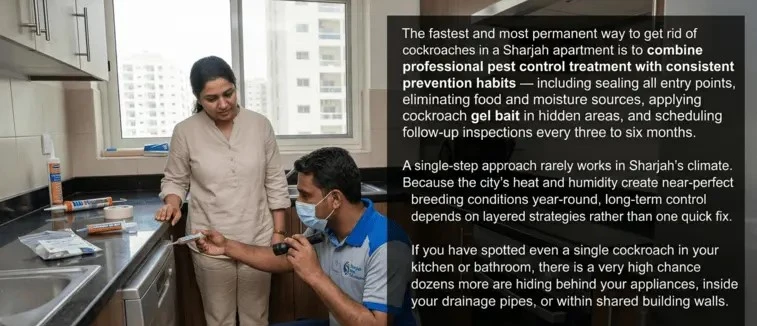
The fastest and most permanent way to get rid of cockroaches in a Sharjah apartment is to combine professional pest control treatment with consistent prevention habits — including sealing all entry points, eliminating food and moisture sources, applying cockroach gel bait in hidden areas, and scheduling follow-up inspections every three to six months. A single-step approach rarely works in Sharjah’s climate. Because the city’s heat and humidity create near-perfect breeding conditions year-round, long-term control depends on layered strategies rather than one quick fix.
If you have spotted even a single cockroach in your kitchen or bathroom, there is a very high chance dozens more are hiding behind your appliances, inside your drainage pipes, or within shared building walls. Acting quickly — and acting the right way — is what separates a short-term reprieve from a genuinely pest-free home.
Why Sharjah Apartments Are So Vulnerable to Cockroach Infestations
Sharjah is one of the most densely populated emirates in the UAE. Residential towers in areas like Al Nahda, Al Majaz, Muwaileh, Al Qasimia, and Rolla are home to thousands of families living in close proximity, sharing plumbing systems, ventilation shafts, and electrical conduits. This shared infrastructure is one of the biggest reasons cockroach problems spread so rapidly here.
The two species most commonly found inside Sharjah apartments are the German cockroach (Blattella germanica) and the American cockroach (Periplaneta americana). The German cockroach is smaller, about 13 to 16 mm long, tan to light brown in color, and incredibly fast at reproducing. A single female can produce up to five egg cases (oothecae) in her lifetime, with each case holding approximately 30 to 40 eggs. Under Sharjah’s warm indoor temperatures, their entire life cycle from egg to breeding adult can be completed in as little as two to three months. The American cockroach, by contrast, is much larger—growing up to 53 mm—and typically enters apartments through sewage systems and floor drains rather than through cracks in walls.
Understanding which species you are dealing with matters because it directly influences which treatment method will actually work.
Beyond species, Sharjah’s climate itself plays a massive role. Temperatures regularly exceed 40°C in summer, and indoor humidity in poorly ventilated apartments creates the warm, moist, dark environment that cockroaches need to breed and thrive. Add in the everyday realities of apartment living—shared garbage chutes, food smells traveling through air gaps, and neighbors who may not maintain the same level of cleanliness—and you have conditions that make infestation almost inevitable without deliberate action.
How to Identify a Cockroach Infestation Before It Gets Out of Control
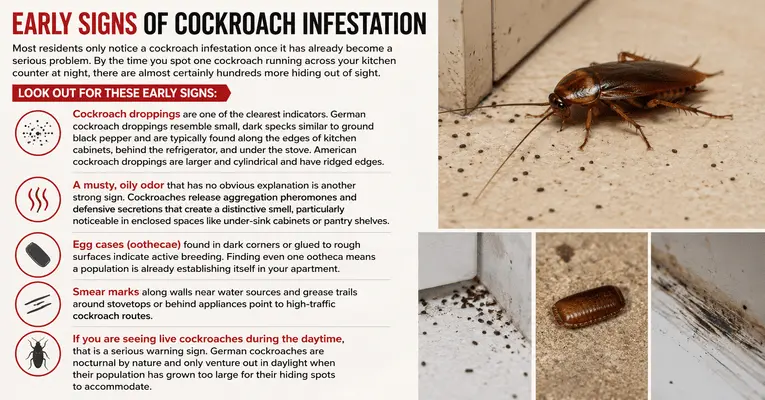
Most residents only notice a cockroach infestation once it has already become a serious problem. By the time you spot one cockroach running across your kitchen counter at night, there are almost certainly hundreds more hiding out of sight.
Look out for these early signs:
Cockroach droppings are one of the clearest indicators. German cockroach droppings resemble small, dark specks similar to ground black pepper and are typically found along the edges of kitchen cabinets, behind the refrigerator, and under the stove. American cockroach droppings are larger and cylindrical and have ridged edges.
A musty, oily odor that has no obvious explanation is another strong sign. Cockroaches release aggregation pheromones and defensive secretions that create a distinctive smell, particularly noticeable in enclosed spaces like under-sink cabinets or pantry shelves.
Egg cases (oothecae) found in dark corners or glued to rough surfaces indicate active breeding. Finding even one ootheca means a population is already establishing itself in your apartment.
Smear marks along walls near water sources and grease trails around stovetops or behind appliances point to high-traffic cockroach routes.
If you are seeing live cockroaches during the daytime, that is a serious warning sign. German cockroaches are nocturnal by nature and only venture out in daylight when their population has grown too large for their hiding spots to accommodate.
Step-by-Step Guide to Getting Rid of Cockroaches in a Sharjah Apartment Permanently
Step One: Deep Clean Every At-Risk Area
Before any treatment can work effectively, your apartment needs a thorough, targeted cleaning focused on the spots cockroaches rely on. This is not about surface tidiness — it is about removing the food, moisture, and shelter that sustain an entire colony.
Start with the kitchen. Pull your refrigerator and stove away from the wall and clean behind them completely. Clear out all cabinets and wipe every shelf with a mixture of white vinegar, water, and a few drops of tea tree oil, which naturally disrupts cockroach pheromone trails. Clean your drains with boiling water or a baking soda and vinegar flush to remove organic residue that cockroaches feed on inside pipes. Ensure all food is stored in airtight containers—open packets of flour, sugar, bread, or lentils are a direct invitation.
Pay equal attention to bathrooms and utility areas. Fix any dripping taps, leaking pipes, or standing water under sinks. Cockroaches can survive for weeks without food but die within days without water. Cutting off their water supply disrupts their ability to sustain a colony.
Step Two: Seal Every Entry Point in Your Apartment
One of the most overlooked steps in permanent cockroach control is physically blocking the routes they use to enter and move through your apartment. In a Sharjah apartment building, cockroaches travel through shared plumbing pipes, ventilation ducts, electrical conduit openings, and cracks in dividing walls.
Use food-grade silicone caulk to seal any visible gaps around pipes where they enter walls and floors. Pay close attention to the area under your kitchen and bathroom sinks where plumbing passes through cabinetry. Install drain covers or mesh screens over floor drains to block the American cockroach’s primary entry point through the sewage system. Check the seals around your front door and any utility panels, as even a gap of just a few millimeters is wide enough for a German cockroach to squeeze through.
Gaps in neighboring walls, shared with adjacent apartments, should be reported to your building management. In older Sharjah apartment buildings, these gaps are extremely common and represent a hidden highway for cockroaches moving between units.
Step Three: Apply Cockroach Gel Bait in Targeted Locations
Cockroach gel bait is currently one of the most effective tools available for apartment infestations, and it works very differently from sprays. Rather than repelling cockroaches (which can actually scatter them further through your apartment), gel bait attracts them with a food-grade compound laced with a slow-acting insecticide. The cockroach feeds on the bait, returns to its harborage, dies, and is then consumed by other cockroaches — effectively spreading the poison through the colony.
Apply small, pea-sized drops of gel bait inside cabinet hinges, along the back inner edges of kitchen drawers, behind the refrigerator, inside the motor housing of the refrigerator (a favorite warm spot for German cockroaches), and inside electrical outlet boxes in the kitchen. Do not place gel bait on surfaces that have been recently cleaned with bleach or disinfectant sprays, as the chemical residue will repel cockroaches from the bait entirely.
Brands like Advion Cockroach Gel and Syngenta Advion are widely used by pest control professionals in the UAE and are available through licensed suppliers in Sharjah. Replace the bait every four to six weeks until all cockroach activity has ceased.
Step Four: Use Boric Acid Powder in Hard-to-Reach Areas
Boric acid is a mineral-based insecticide that has been used safely and effectively in homes for decades. It works by sticking to the cockroach’s body as it walks through it, damaging its exoskeleton and digestive system. Unlike chemical sprays, cockroaches do not develop resistance to boric acid.
Apply a thin, almost invisible layer of boric acid powder along the tops of upper cabinets (where cockroaches walk but humans rarely look), along the inner back of lower cabinets, inside hollow spaces in furniture, and underneath large appliances. The key is a thin layer—a heavy dusting, actually—that repels cockroaches rather than attracting them into contact with the powder. Mixing boric acid with powdered sugar (one part sugar to three parts boric acid) creates an effective bait that draws cockroaches to it.
Keep boric acid applications away from surfaces that children or pets can access, and store the product safely.
Step Five: Hire a Licensed Pest Control Company in Sharjah
For severe infestations, or as a foundational treatment before your own ongoing prevention measures, hiring a licensed pest control company operating under Sharjah Municipality’s guidelines is the most reliable option.
Professional pest control technicians use a combination of spray treatments targeting adult cockroaches and gel bait applications targeting the colony as a whole. They also access areas that most residents cannot — inside wall cavities, drainage systems, and shared utility spaces. A reputable company will offer a two-visit treatment structure: the first visit applies treatment, and the second visit, typically five to seven days later, confirms that the infestation has been eliminated and addresses any remaining activity.
When choosing a pest control company in Sharjah, ask whether their products are approved by the UAE Ministry of Environment and Climate Change and whether their technicians are certified. Eco-friendly, low-toxicity formulations are available and recommended, particularly in homes with young children, elderly residents, or pets.
After treatment, vacate the apartment for at least four to five hours. Avoid mopping or wetting treated surfaces for five days, as this deactivates the spray residue. Follow any specific post-treatment instructions provided by your technician carefully.
Natural and Home Remedies That Actually Help
While natural remedies alone will not eliminate an established infestation, they serve a valuable role as supplementary deterrents and as preventive measures once the main infestation has been dealt with.
Bay leaves contain eucalyptol, a compound that cockroaches find deeply repellent. Place whole dried bay leaves inside cabinets, pantry shelves, and drawers. They are completely safe around food, children, and pets and need to be replaced every two to three weeks as their essential oils fade.
Diatomaceous earth (food-grade) is a fine powder made from fossilized algae that dehydrates cockroaches by penetrating their exoskeleton. Lightly dust it along the base of walls, behind appliances, and inside cabinet corners. It remains effective indefinitely unless it gets wet.
Essential oils, including peppermint, eucalyptus, lavender, and cedarwood, can be diluted in water and sprayed around window frames, door edges, and vents as a deterrent. Cockroaches are highly sensitive to these volatile compounds and will avoid areas where concentrations are strong.
Baking soda and sugar mixed in equal parts and placed in shallow dishes near cockroach activity areas can kill individual cockroaches, as the baking soda reacts with their stomach acids after ingestion. However, this method works slowly and is best used alongside more potent treatments.
How to Prevent Cockroaches from Coming Back
Permanent control is not just about elimination—it is about creating conditions where cockroaches cannot survive long enough to re-establish themselves. In a Sharjah apartment, this requires building consistent daily and monthly habits.
Daily habits that make a significant difference include wiping down stovetops and kitchen counters after every meal, never leaving unwashed dishes in the sink overnight, taking out garbage before the end of the day, and ensuring all drains in kitchens and bathrooms are covered when not in use.
Weekly habits should include sweeping under appliances, checking beneath the refrigerator and stove for droppings or bait that needs refreshing, inspecting under-sink areas for moisture or new entry points, and wiping down the inner backs of food storage cabinets.
Monthly habits that prevent re-infestation include refreshing boric acid or gel bait applications, replacing bay leaves in cabinets, checking drain covers and pipe seals for damage, and inspecting any cardboard boxes or deliveries that enter the apartment (cockroaches frequently arrive in cardboard packaging and grocery bags).
For apartments in older Sharjah buildings or those located near restaurants, grocery stores, or garbage collection areas in Al Rolla, Al Jubail, or Al Wahda commercial zones, scheduling professional pest inspections every three to six months is a genuinely worthwhile investment in your health and quality of life.
Health Risks of Ignoring a Cockroach Infestation
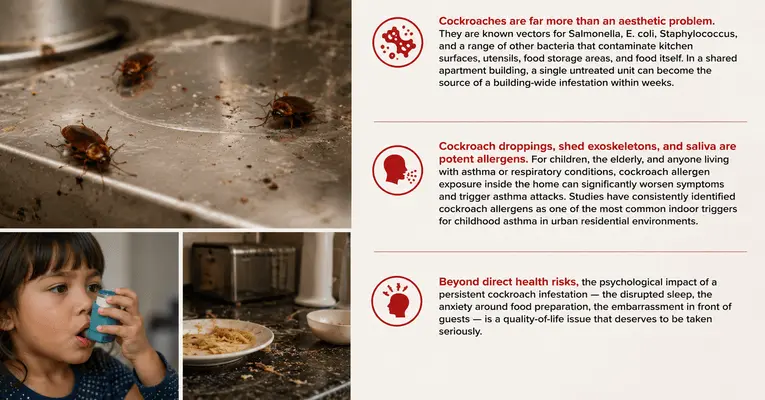
Cockroaches are far more than an aesthetic problem. They are known vectors for Salmonella, E. coli, Staphylococcus, and a range of other bacteria that contaminate kitchen surfaces, utensils, food storage areas, and food itself. In a shared apartment building, a single untreated unit can become the source of a building-wide infestation within weeks.
Cockroach droppings, shed exoskeletons, and saliva are potent allergens. For children, the elderly, and anyone living with asthma or respiratory conditions, cockroach allergen exposure inside the home can significantly worsen symptoms and trigger asthma attacks. Studies have consistently identified cockroach allergens as one of the most common indoor triggers for childhood asthma in urban residential environments.
Beyond direct health risks, the psychological impact of a persistent cockroach infestation — the disrupted sleep, the anxiety around food preparation, the embarrassment in front of guests — is a quality-of-life issue that deserves to be taken seriously.
When to Call Sharjah Municipality or Your Building Management
In Sharjah, if a cockroach infestation is originating from shared building infrastructure—common drains, building basement areas, garbage chutes, or neighboring units—you have the right to report it to Sharjah Municipality or raise it formally with your building management company.
Under UAE health and hygiene regulations, landlords and building managers are responsible for maintaining shared areas free from pest infestations. Document evidence of the infestation with photographs and written records before making a formal complaint. In many cases, coordinated building-wide treatments organized by management are far more effective than individual apartment treatments alone because they address the root cause rather than just the symptoms in a single unit.
Frequently Asked Questions About Cockroach Control in Sharjah
How long does it take to get rid of cockroaches completely in a Sharjah apartment? With professional treatment combined with gel bait application and consistent prevention, most infestations show 90% reduction within five to seven days. Complete elimination typically takes two to four weeks. Ongoing prevention measures are needed to prevent re-infestation.
Can cockroaches come back after professional pest control? Yes, they can—particularly in apartment buildings with shared infrastructure. This is why post-treatment prevention habits and periodic follow-up inspections are essential. Professional treatment eliminates the existing colony; your daily habits determine whether a new one can establish itself.
What is the best cockroach killer available in Sharjah? Cockroach gel baits using active ingredients like indoxacarb or fipronil are considered among the most effective available. Combined with boric acid powder in inaccessible areas and silicone sealing of entry points, these products form the backbone of effective professional and DIY cockroach control.
Are cockroach treatments in Sharjah safe for children and pets? Licensed pest control companies in Sharjah use formulations approved under UAE Ministry of Environment standards. Most modern treatments are low toxicity and safe once they are dry. Always vacate the apartment for the recommended period after treatment and follow your technician’s aftercare instructions.
Why do cockroaches keep coming back to my Sharjah apartment? Recurring infestations almost always indicate an unaddressed entry point, an active population in shared building infrastructure, or a hygiene or moisture issue that is being overlooked. A building-wide coordinated treatment—not just treatment in your individual unit—is often the only permanent solution in multi-story residential buildings.
Getting rid of cockroaches in a Sharjah apartment permanently is absolutely achievable. It requires understanding why they are there in the first place, choosing the right combination of treatments, and building the prevention habits that make your home an environment where cockroaches simply cannot survive. Start with the steps above, stay consistent, and do not hesitate to bring in licensed professionals when the scale of the problem calls for it.
